The Moral Machine Experiment
Some insights about cultural differences!
Imagine a self-driving car whose brakes have just failed. Straight ahead, it will hit a group of pedestrians crossing the street; if it turns, it will kill its own passengers. What should it do? What if instead of pedestrians there were children, or pets or elderly or someone passing a red light? These are the kinds of questions the Moral Machine asks. It’s an online platform that presents visitors with random variations of this situation, basically trying to reflect on the ethical dilemma faced by autonomous car builders.
The project was built by researchers at MIT with the goal of gathering, at planetary scale, the moral intuitions that people across different cultures bring to these life-and-death tradeoffs. The motivation is practical as well as philosophical: as machines start making decisions that used to be left to humans, whose ethics should they be programmed with?
The results were published in many papers, e.g. in Nature in 2018 The Moral Machine experiment, and the scale is what makes the study remarkable: nearly 40 million decisions collected from around 4 million participants across 233 countries and territories. It seems that it’s one of the largest studies of moral preferences ever conducted.
kinds of trade-offs the test takers are faced with:
- sparing males over females,
- sparing humans over animals,
- sparing more lives over fewer,
- sparing the young over the old,
- sparing pedestrians over passengers,
- sparing those who obey traffic laws over jaywalkers.
When I first got to know this experiment in an ethics class, I got interested to see the differences between cultures and I realized in many areas, my preconceived understanding is much different from the reality. In some other cases, I understood why some countries, or their nationals behave as they do.
I found this website that created a very nice graphical interface out of the results of this experiment, where you can compare countries based on each moral factor. I chose Italy (the country I’m currently residing in) as a reference, and compare it to other regions of the world.
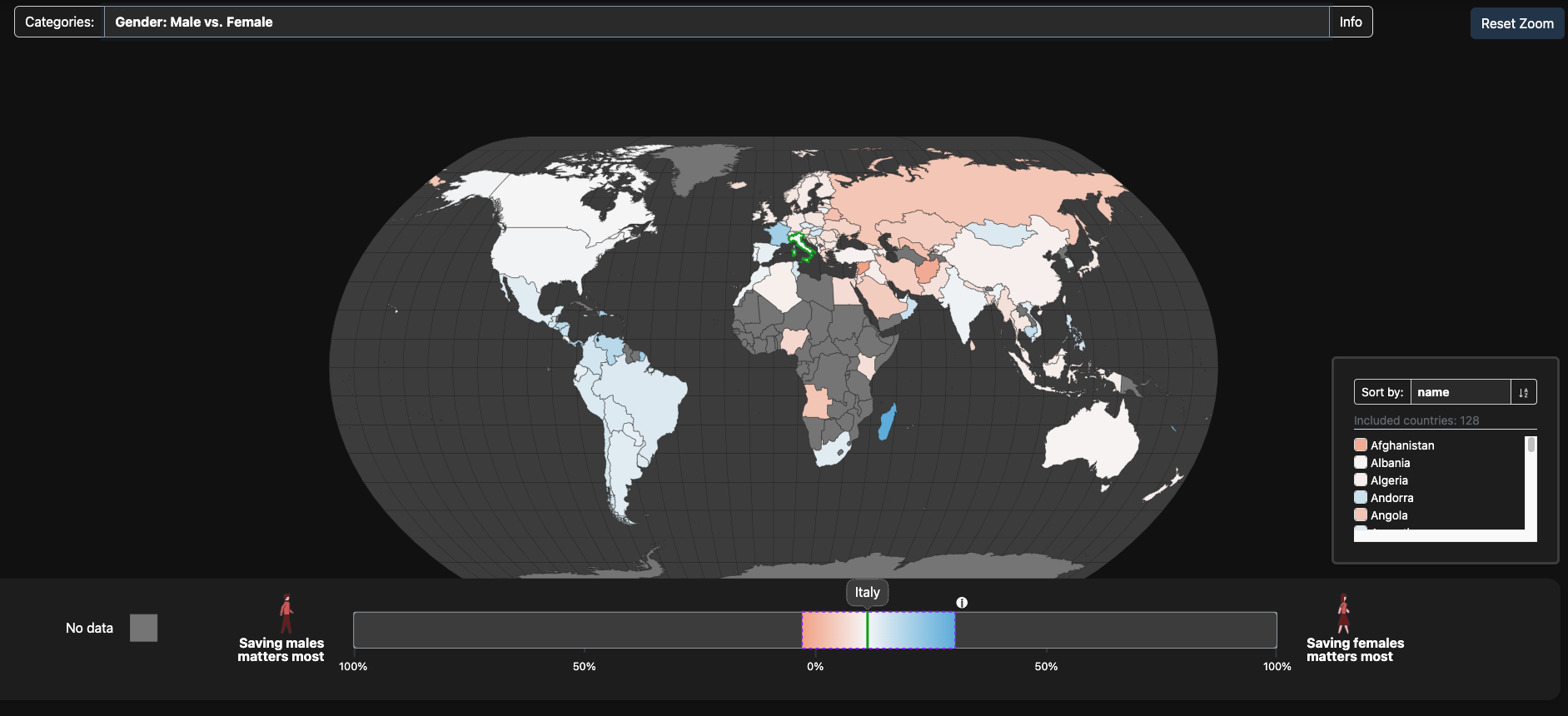
First, on the Male/Female scale, you see the Western World is more or less female oriented (saving females more) while the Middle East, Russia and Eastern Europe lean more toward males. It seems Asian countries like China, India and Japan are in the middle of the scale, which might have some correlation with economic development. Generally, nothing surprising here for me.
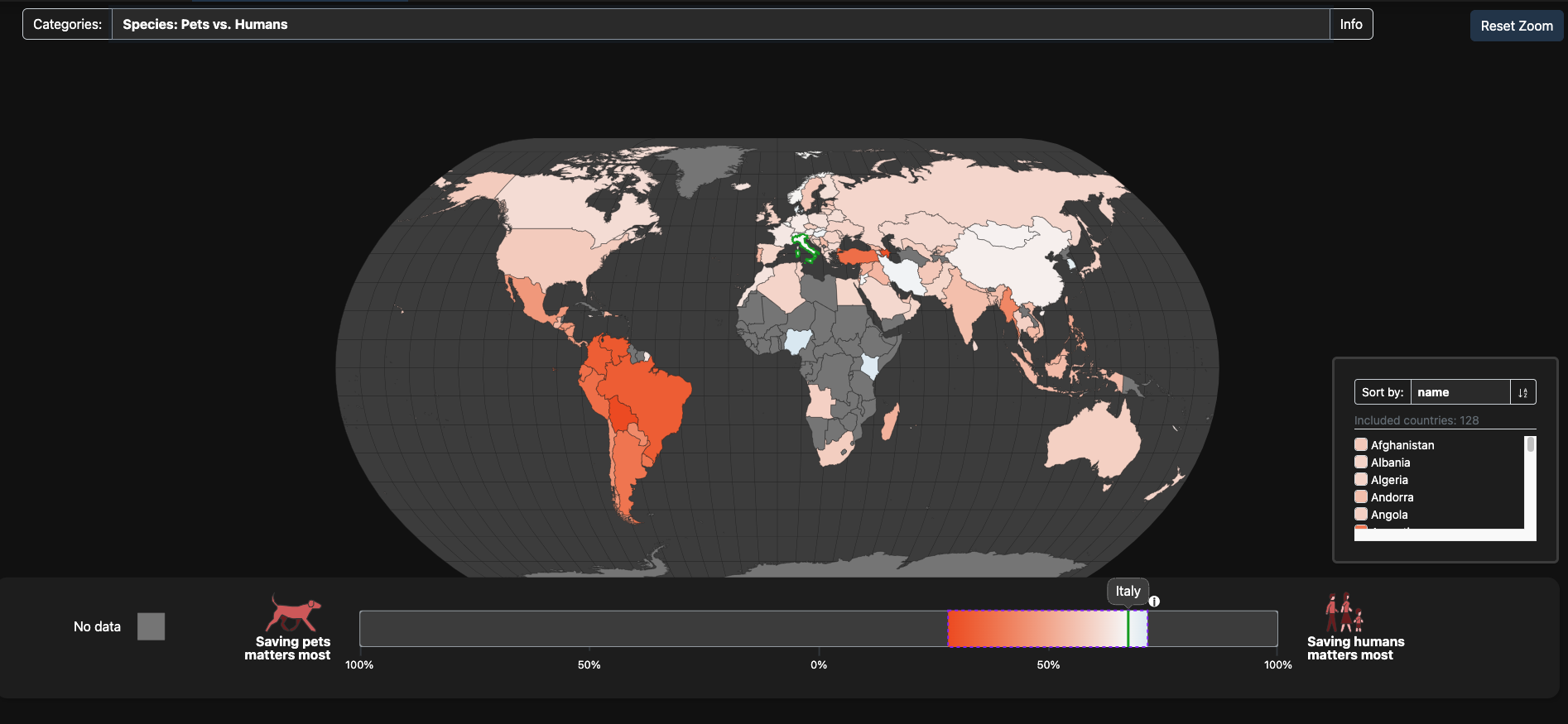 Italy being at the extreme end of the scale on saving humans vs. pets really surprised me, given that almost 63% of Italians own some kind of pet, with dogs being the most popular type among owners. Another interesting insight is that South America is completely orange, meaning they mostly preferred saving pets over humans. Also Turkey and Azerbaijan (which we know have very similar cultures) are very orange. I wish I knew why Turkey is so different in this aspect compared to its neighboring countries. Also, Iran is almost white, which I think relates to pets not being very popular, though that is changing in newer generations.
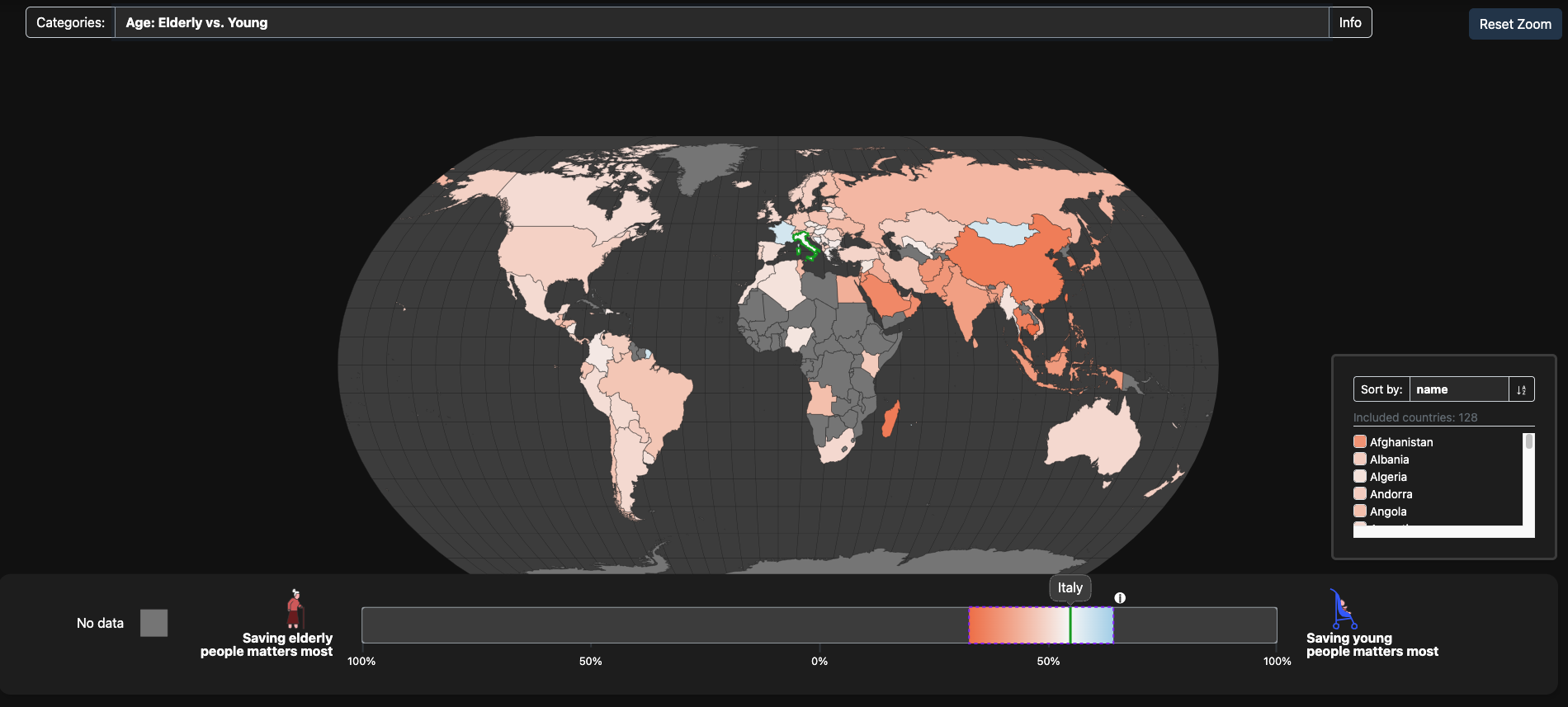 In the domain of age, Asian countries, especially China, are very respectful toward the elderly, a famous aspect of their cultures. It is interesting that Latin cultures, especially Italy and France and then Spain, are very young oriented cultures. The countries under their cultural influence in South America, like Colombia which was a Spanish colony for 3 centuries, are the same.
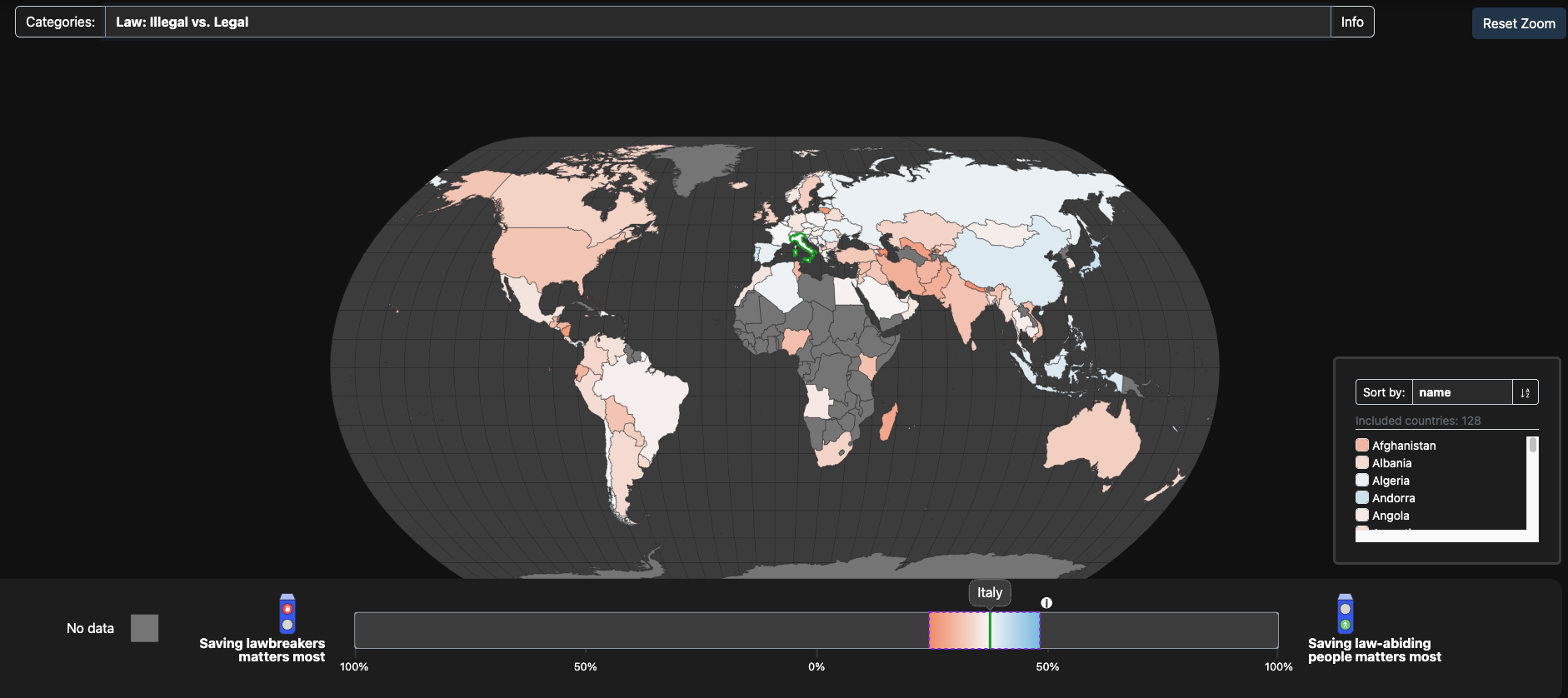 I expected the western world to be relatively more law abiding compared to the east, but it seems China and Russia are among the most law abiding nations (I'm not sure, but it might be related to the rigid totalitarian regimes that have strict control over the population). The Middle East does not have a good standing here, as well as the United States and many South American countries. In Europe, Lithuania is an interesting outlier. Generally, Anglo-Saxon cultures do not seem to me as law-respecting as I was expecting.
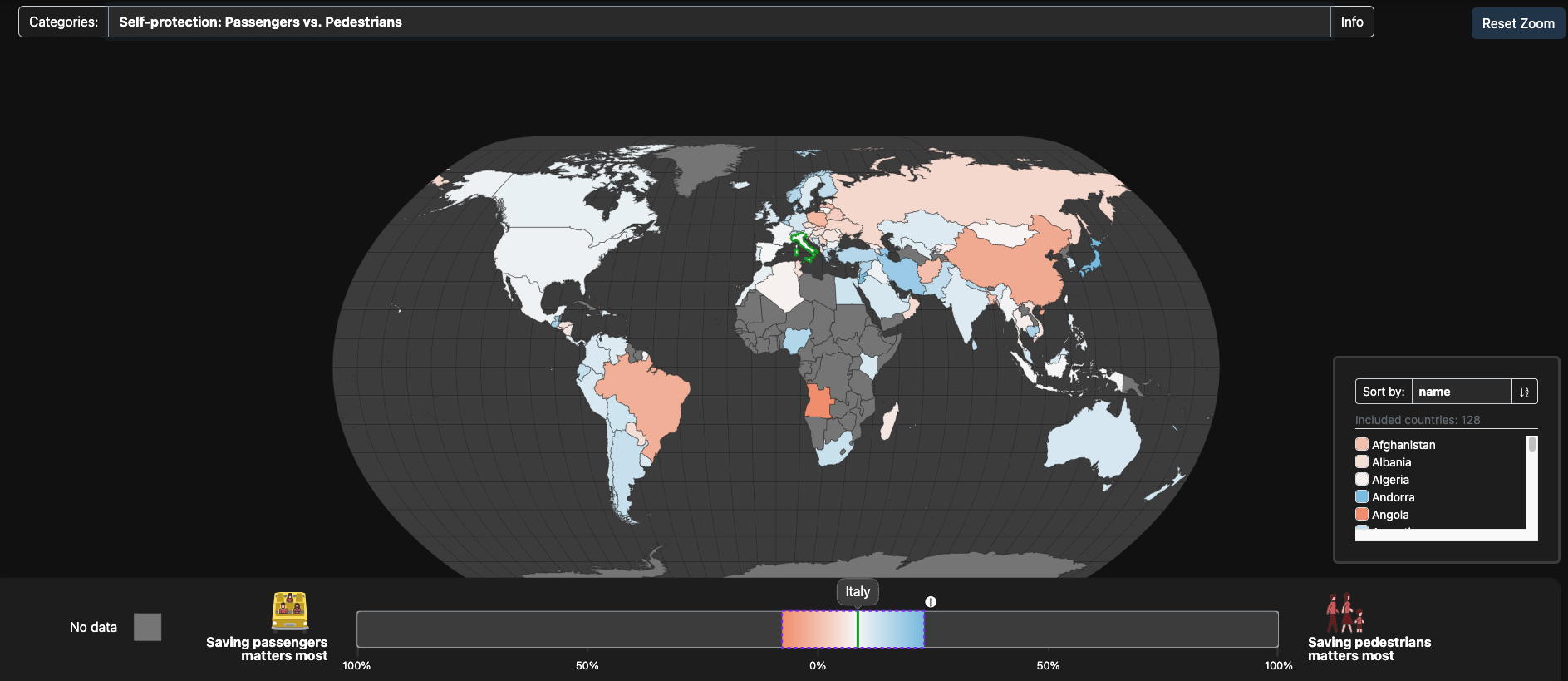 On the matter of sparing passengers (self-protection), if we can read this as a proxy for selfishness, China and Brazil are at the front, coming across as quite self-centered cultures. Iran, on the other end, is very caring toward others, which is what I'd expect from emotional and hospitable people. What caught my attention here is how China and Japan sit at the two extremes of the spectrum, with Japan appearing as a very selfless country. It's also interesting how Brazil stands apart from almost all the other South American countries.
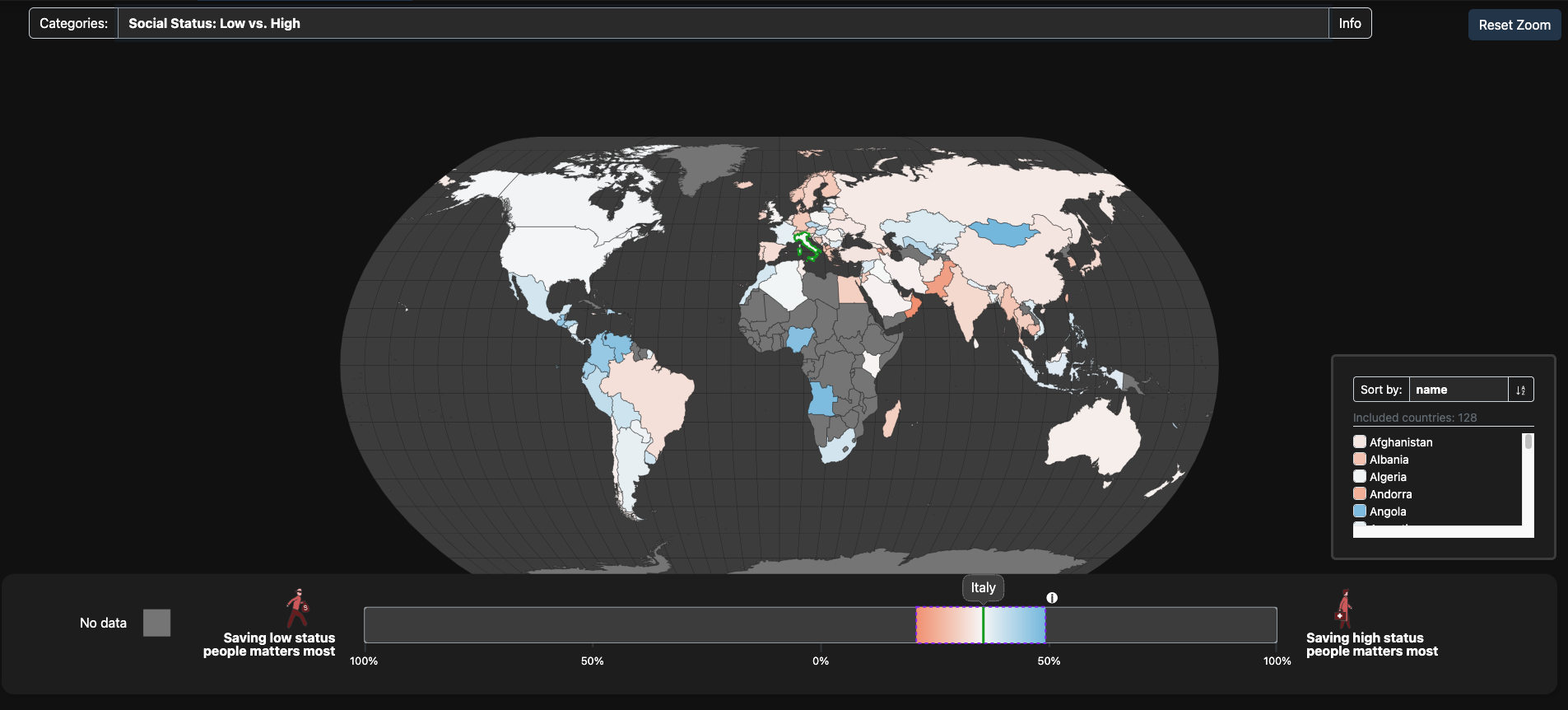 On the matter of social status, it is evident that Europe has some left-leaning tendencies when it comes to caring for the poor and weaker members of society, especially in the Scandinavian countries. On the other hand, South Americans, except for Brazilians, tend to place a lot of value on the rich and high-status. In Asia, Armenia stands out as an interesting outlier.
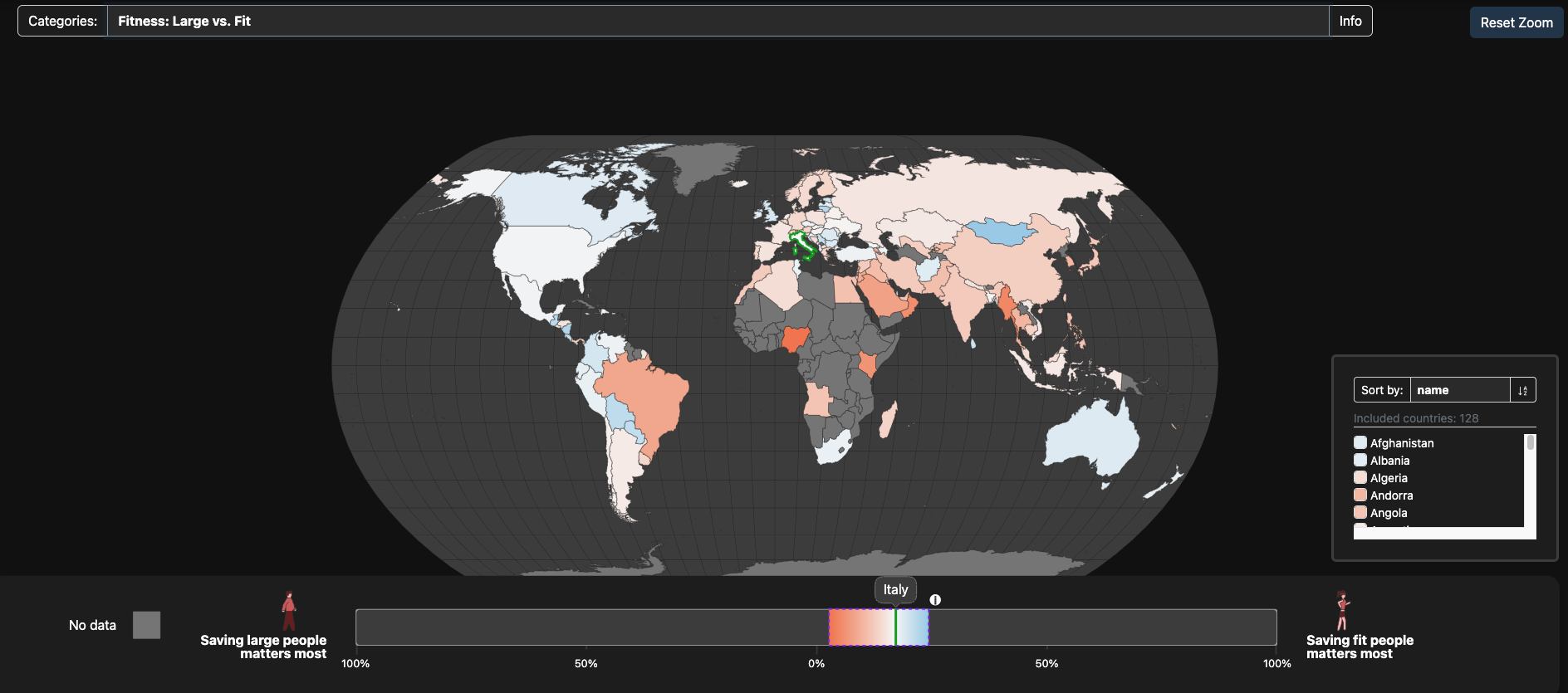 Finally, how seriously should we take going to the gym? It seems to depend on the country we live in. The Anglo-Saxon countries (UK, US, Canada, and Australia) all seem very focused on being fit, while the Middle East generally doesn't show much concern about it. Once again, it's striking how Brazil stands apart from its neighboring countries by being on the less-fit side, quite contrary to everyone's expectations, I guess!